(vasep.com.vn) The global shrimp industry enters 2025 amid significant turbulence. Rising tariffs, rapidly shifting demand, and intense competitive pressures have compelled the largest exporting countries to adapt and reorient their strategies. Among them, India, Ecuador, and Indonesia stand as typical examples of this shifting trend.
India: Tariff Burdens and Efforts to Rebalance
India is facing significant challenges as the United States imposed tariffs exceeding 50% on imported shrimp starting from the end of August 2025. Nevertheless, the country’s shrimp industry has managed to maintain its growth momentum. In the first seven months of 2025, India exported 414,729 tons, up 2% compared to the same period, with export value reaching USD 2.94 billion, 12% higher than the previous year. In July alone, exports reached 68,527 tons, valued at USD 491 million.
The United States remains the largest market, accounting for 179,935 tons in the first seven months, up 9% year-on-year. However, the most notable bright spot lies in Europe, where imports from India increased by as much as 27%, reaching 58,287 tons. In addition, processed value-added products are playing an increasingly important role, totaling 44,288 tons in the first seven months, up 34%. This represents a strategic direction for India to reduce its dependence on the U.S. market.
Ecuador: Diversification and Breakthrough in the Processed Segment
Ecuador continues to affirm its leading position in the shrimp industry, with 826,577 tons exported in the first seven months of 2025, up 16% in volume and 25% in value, reaching USD 4.36 billion. China remains the largest market, accounting for more than 400,000 tons, although growth has slowed. Notably, exports to the EU reached 157,364 tons, up 34%, while exports to the United States reached 151,432 tons, up 13%.
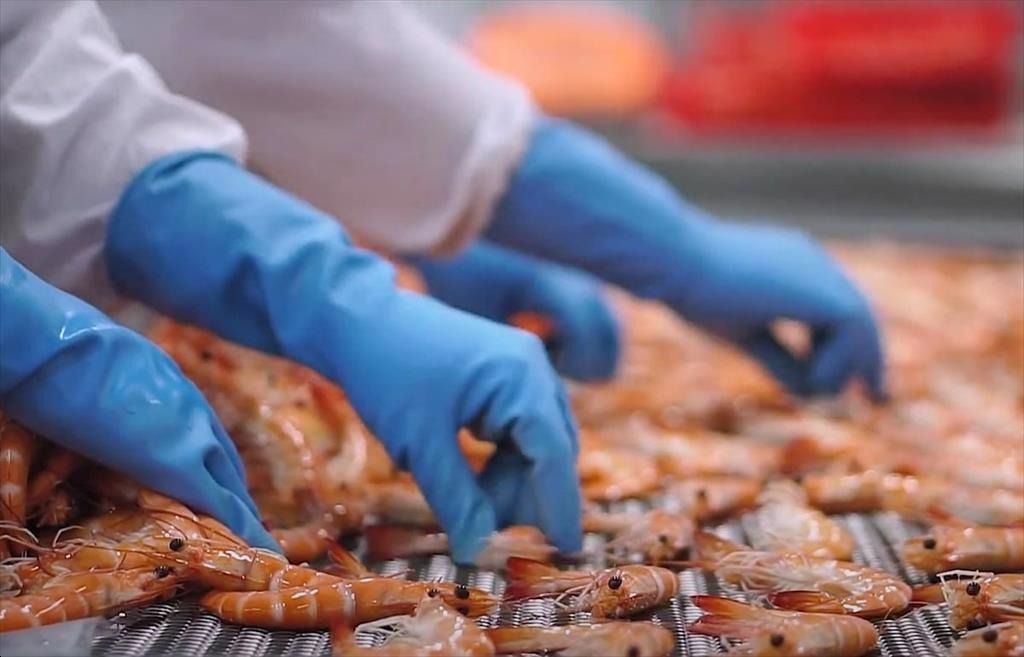
Ecuador’s key strategy is to accelerate the development of processed products. From 127,980 tons of value-added shrimp in 2020, the country increased this figure to 268,720 tons in 2022—doubling within just two years. Peeled, quick-cleaned, and ready-to-cook products have enabled Ecuador to penetrate deeper into premium markets, while also reducing the risks associated with excessive dependence on China as in the past.
Indonesia: The Challenge of Reducing Dependence on the U.S. Market
Indonesia is facing significant pressure as up to 60% of its shrimp exports depend on the U.S. market—where import tariffs reach 19%. In the first seven months of the year, Indonesia exported 122,785 tons, up 13% in volume and 23% in value, reaching USD 1.04 billion. However, of this total, 80,415 tons were shipped to the United States, leaving the market structure overly imbalanced.
To adapt, Indonesia has begun expanding into other markets. Exports to China reached 7,285 tons, up 36%, while exports to the EU reached 5,863 tons, up as much as 53%. Processed products, particularly boiled shrimp, marinated shrimp, and breaded shrimp, are generating strong growth momentum, while black tiger shrimp continues to decline. Nevertheless, Indonesia still requires additional time and resources to reduce its heavy dependence on the U.S. market.
The U.S. and EU: The Decisive Arenas of the Shrimp Industry
The United States and the EU remain the two most critical markets for the global shrimp industry. In the first seven months of 2025, the United States imported 486,069 tons of shrimp, valued at USD 4.05 billion, up 18% and 27%, respectively. India remained the leading supplier with 192,552 tons, followed by Ecuador with 131,240 tons and Indonesia with 83,663 tons.
In Europe, seven-month imports reached 249,302 tons, valued at EUR 1.59 billion, up 21% in volume and 27% in value. Ecuador continued to be the largest supplier with 139,078 tons, while India and Vietnam also recorded strong growth, reaching 31,077 tons and 29,787 tons, respectively.
Lessons for Vietnam
The reorientation strategies of India, Ecuador, and Indonesia offer important lessons for Vietnam. First, dependence on a single market always entails significant risks. Ecuador succeeded by diversifying in a timely manner, while Indonesia continues to struggle due to its close attachment to the U.S. market. In addition, investment in deep processing is key to enhancing profit margins and meeting new demand from the United States and the EU.
Global consumers increasingly favor convenient products—from ready-to-eat to ready-to-cook—while also demanding sustainability and traceability. This presents an opportunity for Vietnam to strengthen its role as a global processing hub, provided that supply chain transparency is ensured and a national brand associated with sustainability is established.
In the volatile landscape of seafood trade, flexible reorientation has proven to be a matter of survival. India, Ecuador, and Indonesia have each adopted different approaches; those who proactively diversify markets and invest in value addition and sustainability will maintain their positions. Vietnam must leverage these lessons not only to safeguard its market share but also to enhance the value of its national shrimp brand.